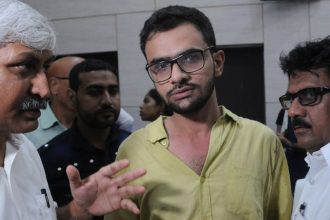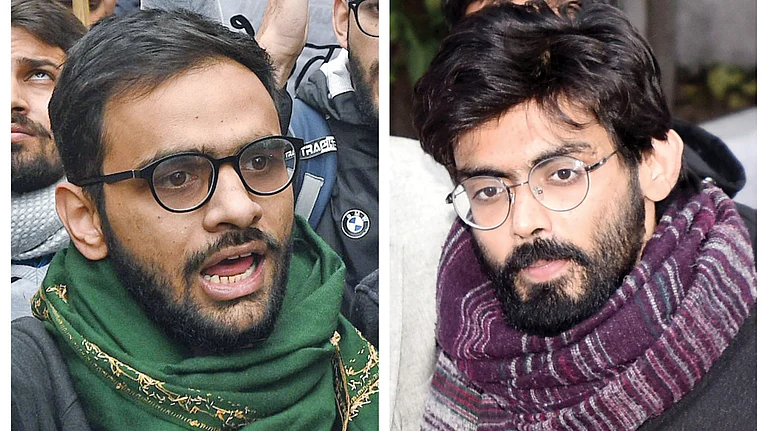
Shafaqna India: A Delhi court on Saturday rejected the bail pleas of Umar Khalid and Sharjeel Imam in the larger conspiracy case linked to the 2020 North East Delhi riots, holding that it could not entertain their applications in view of the Supreme Court’s earlier order refusing them bail.
Additional Sessions Judge Sameer Bajpai of the Karkardooma Courts dismissed the pleas, observing that the legal issue surrounding bail in delayed UAPA trials had already been referred to a larger bench by the Supreme Court and remained unresolved.
The court said it was bound by the Supreme Court’s 5 January order denying bail to Khalid and Imam, which had made it clear that they could renew their request only after the examination of protected witnesses or on the expiry of one year from that order, whichever came earlier.
“Following the said order of the Hon’ble Supreme Court, this court cannot entertain the applications and grant bail to the applicants. In fact, the applications are not maintainable and are hereby dismissed,” the judge said.
Live Law reported that the court also noted that the Supreme Court’s ruling in the cases of Gulfisha Fatima and Syed Iftikhar Andrabi had since been referred to a larger bench, and until that issue was settled, it could not independently consider the pleas of Khalid and Imam on any other ground.
Also Read: Delhi HC grants bail to Kashmiri activist in UAPA case, cites prolonged incarceration
Appearing for Khalid, senior advocate Trideep Pais argued that there had been a change in circumstances since the Supreme Court’s earlier order, including later judicial developments on prolonged incarceration in UAPA cases.
Pais submitted that Khalid had remained in continuous custody, that there was no recovery from him, no statement leading to discovery, no allegation of direct violence and only one speech video from Amravati recorded 17 days before the riots.
Pais also referred to the Supreme Court’s interim bail order in favour of co-accused Tasleem Ahmed and Khalid Saifi and said the broader question of delayed trials under the UAPA was now under reconsideration.
Counsel for Sharjeel Imam argued that he had already spent nearly six years in custody and that the trial showed no sign of concluding any time soon. It was submitted that arguments on charge were still incomplete and that Imam should receive the benefit of relief granted to other accused in the case.
The prosecution opposed both pleas, contending that the Supreme Court had expressly barred fresh bail requests before the completion of the protected witnesses’ examination or the expiry of one year from its January order. It also pointed out that a review petition filed against that order had already been dismissed.
The present applications were filed after a separate Supreme Court bench questioned the legal reasoning in the 5 January ruling, which had granted bail to several other accused, including Gulfisha Fatima, Meera Haider, Shifa Ur Rehman, Mohd Saleem Khan and Shadab Ahmed, but refused relief to Khalid and Imam.
Subsequently, a coordinate bench of the Supreme Court expressed reservations over whether that judgment had properly applied the 2021 ruling in Union of India v. K.A. Najeeb, in which a three-judge bench had recognised prolonged delay in trial as a valid ground for bail even in UAPA cases. In May, another bench, while rejecting the pleas of Khalid and Imam, referred the apparent conflict in precedent to a larger bench.
The case arises out of FIR 59 of 2020, being investigated by the Delhi Police Special Cell under various provisions of the Indian Penal Code and the Unlawful Activities (Prevention) Act. It concerns allegations of a larger conspiracy behind the communal violence in North-east Delhi in February 2020.