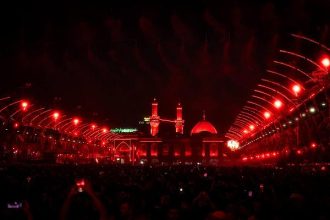
Shafaqna India | by Dr Abolfazl Fateh: Now that the banner of mourning for Imam Hussain (AS) has spread across the world, while at the same time opponents have drawn the sword of distortion, every public act performed in the name of Shi’ism contributes to either reinforcing or reshaping the global image of this school of thought in the minds of public opinion. We must all recognize that, in today’s world, Shi’ism constitutes an interconnected identity, and that Ashura and Arbaeen form a vital part of the global image and perception of Shi’ism.
In the Name of God, the Most Compassionate, the Most Merciful
Ashura in the Global Public Sphere: Identity, Wisdom, and Responsibility
Imam Hussain (AS) was the reviver of religion, the heir of Adam, and the unparalleled model for humanity. In an age when, in today’s terminology, the world was subject to the colonization of minds and the siege of meaning, where truth and falsehood, virtue and vice, religion and worldly power were all interpreted through the hegemonic lens of the Umayyad regime, Hussain (AS) brought forth the dearest of lives and the loftiest of truths to expose the moral decay of his era and liberate truth from the captivity of the official narrative of corrupt power.
Ashura is the moment when truth was freed from the tyranny of Yazid’s rule, and Karbala is not merely the turning point of Islamic history but the beginning of an eternal moral divide. As the poet Mohtasham Kashani described it, Ashura is “the Resurrection of this world,” rising “to the Highest Throne without the trumpet’s blast.” It is also the universal language of humanity and freedom, and both dimensions must be conveyed to every generation and every age.
From this perspective, reflecting upon its teachings, revisiting its principles, and mourning the sufferings of the “Slain of Tears” are not merely religious traditions; they constitute a human obligation, an essential component of identity, and a civilizational mission. Whoever considers themselves the bearer of this movement’s message carries the heavy responsibility of representing it faithfully before all generations and throughout all ages.
Today, by the grace of God, through the truth of Imam Hussain (AS), the growing awareness of Shi’as, and the migration of Shi’a communities around the world, the banner of mourning for the Master of Martyrs has become global. At the same time, however, opponents have intensified their efforts to distort its image. With regard to how this great heritage is represented—especially in Western societies or societies unfamiliar with Shi’ism—I offer several reflections.
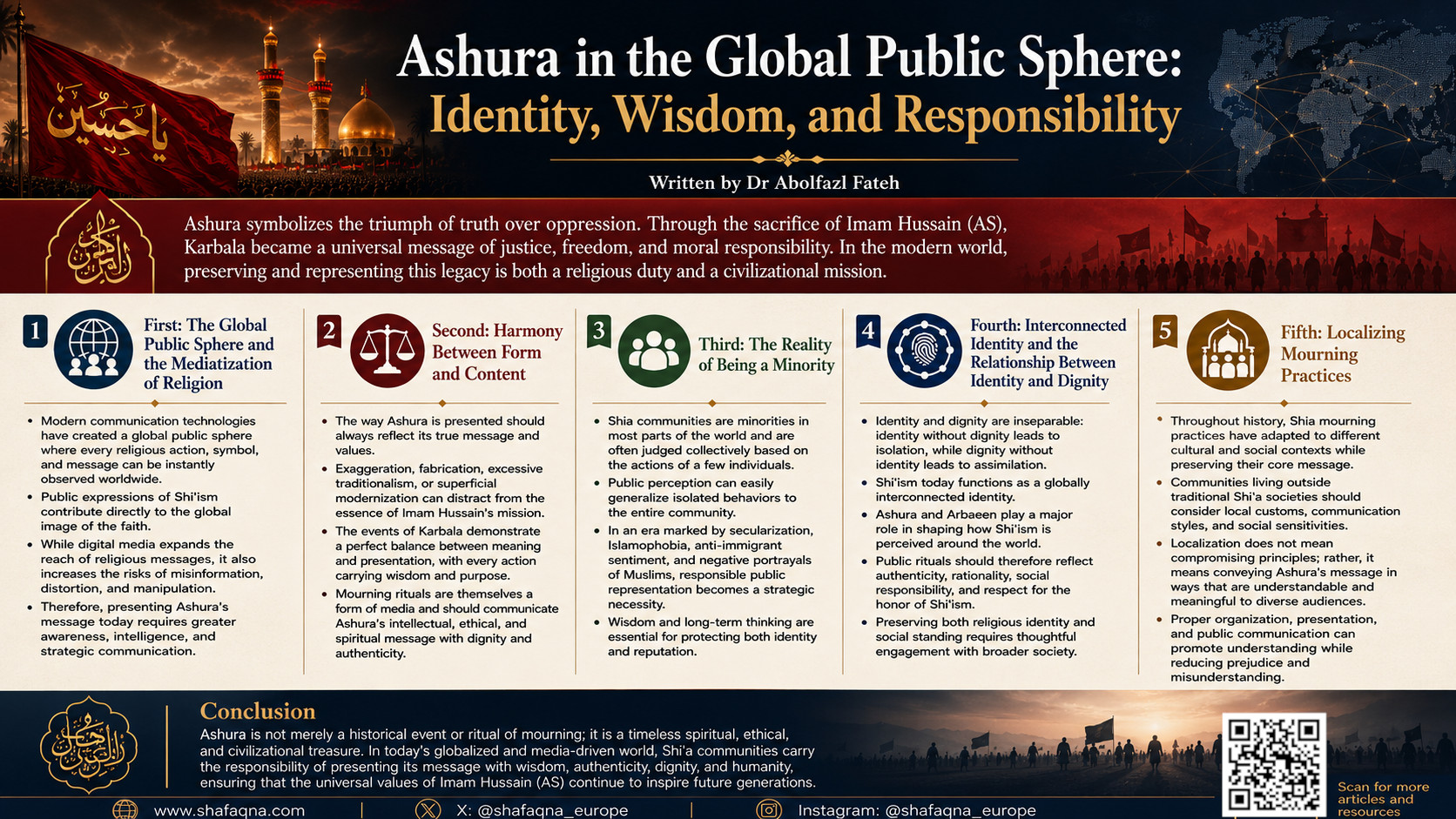
First: The “Global Public Sphere” and the Mediatization of Religion
Advances in information technology and the collapse of media boundaries have transformed the concept of a global public sphere into reality within today’s interconnected world.
In a networked world, no public action remains confined to its original time and place. Every act, word, symbol, and ritual—whether positive or negative—is recorded by the media and becomes subject to observation, interpretation, and judgment by millions of people from different cultures, religions, and nations.
In such an environment, every public act performed in the name of Shi’ism is no longer merely an individual or local behavior. Every public ritual, and everything seen or heard in the name of religion, contributes to constructing or reconstructing the global image of Shi’ism in the minds of the public.
On one hand, we are witnessing the mediatization of religion, where religious messages now travel far beyond pulpits and minarets into the digital universe. On the other hand, in the age of the internet and artificial intelligence—with all of their tremendous benefits—the flood of misinformation, distortion, fabrication, and manipulation of narratives has reached unprecedented proportions.
Under such circumstances, producing, presenting, and monitoring every religious message—and ensuring that it passes through increasingly complex mechanisms of distortion—requires exceptional precision, intelligence, and vigilance.
Second: Harmony Between Form and Content
There is no doubt that form is the environment in which meaning lives, and structure safeguards ideas.
Any method that distracts minds from the essence of the message—whether through exaggeration, negligence, fabrication, or excess; whether by clinging to traditionalism in ways that hinder meaningful communication with contemporary audiences; or by sacrificing authenticity in the name of modernization—is incompatible with the philosophy of mourning Imam Hussain (AS).
Reflecting on the journey of the Caravan of Ashura from Medina to Karbala, one finds that every action, every speech, every choice, every scene, and every location served a magnificent purpose.
From the sermons and dialogues of Imam Hussain (AS) and Lady Zaynab (SA), to the arrangement of the camps and the army; from the eve of Ashura to the noon prayer on the day of battle; from the legendary loyalty of Abbas to the martyrdom of the six-month-old infant Ali al-Asghar; and from the dignity and steadfastness of the Prophet’s Household on the afternoon and evening of Ashura—everything was marked by perfect wisdom, spirituality, and proportion. Each element became a vehicle for revealing the fullness of truth and faithfully conveying Karbala’s universal message.
Even historical reports describing the Imam’s neat appearance and the cleanliness of his companions reveal the profound connection between meaning and symbol, between truth and the manner of its manifestation.
Mourning itself is a form of media.
Throughout the centuries, devotees of Imam Hussain (AS) have employed countless mediums—sermons, pilgrimage texts, books, poetry, passion plays (ta’ziyeh), gatherings, processions, chest-beating ceremonies, elegies, and more recently cinema, photography, social media, and the massive Arbaeen pilgrimage—to communicate the message of Muharram.
Scholars have consistently emphasized that the form must remain proportionate to the message. Every medium chosen should be capable of conveying this profound intellectual and ethical tradition through noble language, wise conduct, and a structure suited to the understanding of each era, while remaining as faithful as possible to the essence and ultimate purpose of Hussain’s movement.
Third: The Reality of Being a Minority
Minority status arises from the intersection of demographic, historical, political, and social realities.
Minorities are judged more readily than majorities. The behavior of a few members is often attributed to the entire community, consciously or unconsciously.
For this reason, minorities are especially vulnerable to identity generalization, whereby a single action by an individual or a small group may shape public judgment about an entire community, religion, or collective identity.
Accordingly, long-term vision and wisdom in public representation are not merely moral virtues for minorities—they are strategic necessities.
With the exception of a handful of countries, Shi’a communities constitute minorities on both regional and global scales.
Meanwhile, the contemporary world faces growing secularization and religious disengagement, alongside the rise of far-right movements, increasing Islamophobia, anti-immigrant sentiment, and organized efforts to tarnish the image of Muslims—particularly Shi’as.
The combination of minority status with these broader circumstances imposes unique identity, social, and strategic responsibilities upon Shi’a communities, especially regarding their public presence.
Fourth: An “Interconnected Identity” and the Inseparability of Identity and Dignity
As previously discussed in relation to the strategic way of life for Shi’ism, identity and dignity are inseparable for minorities.
Identity without dignity leads to isolation, while dignity without identity risks assimilation.
The experience of several religious minorities in the West demonstrates that through strategic prudence, restraint, and thoughtful public engagement, communities can preserve both their identity and their social standing.
If a minority is misrepresented, it is not only its rights that suffer, but also its identity and future.
Shi’a tradition likewise offers clear guidance through reason, prudent discretion (taqiyyah), and concern for the common good, particularly in the public sphere.
We must all recognize that Shi’ism today is an interconnected identity, and that Ashura and Arbaeen are essential components of the global image and perception of Shi’ism.
Accordingly, the thoughtful representation of rituals and symbols takes on even greater importance.
Individuals or groups may observe religious rituals according to their own traditions within private settings or specific communities. However, in the public sphere and under the banner of the Ahl al-Bayt, adherence to principles such as authenticity, rationality, the common good, dignity, and the honorable representation of Shi’ism is indispensable.
I recall that The Grand Ayatollah Ali al-Sistani stated in September 2012, addressing Shi’as living in the West:
“No one knows what the future holds. Shi’as must be vigilant: first, to preserve their identity; second, to strive for an honorable social position so that the dignity of Shi’ism is maintained; and third, to live in such a way that they cannot be discarded as though they were merely expendable members of society whenever others choose.”
Fifth: Localizing Mourning Practices
The history of Shi’ism demonstrates that mourning rituals have always been intertwined with the cultures and traditions of the societies in which they are practiced. What is familiar and culturally resonant in Iraq may not be so in Iran, and what is customary in Iran may not be familiar in Europe. Such diversity is not a sign of fragmentation but rather testimony to Shi’ism’s enduring capacity to engage with diverse cultural environments while conveying a single, universal message through different forms and media. Accordingly, it is fitting that Shi’a communities living abroad give due consideration to the localization of mourning practices within the particular civilizational context in which they reside.
Just as Shi’a jurisprudence requires ijtihad—grounded in the Qur’an and the Prophetic tradition—to preserve its relevance amid changing times and circumstances, so too does the transmission of Ashura’s message require, alongside unwavering fidelity to its authentic foundations, an understanding of the demands of the age and the characteristics of the surrounding environment. This is not a call to seek public approval at any cost. Rather, it is expected that both the themes and forms of mourning, while remaining firmly rooted in and committed to the principles and essence of the tradition, also take into account the host society’s public culture, social sensitivities, modes of understanding, and language of communication, enabling meaningful interaction and dialogue with the broader community.
In this regard, not only the quality of the form, the manner of observance, its dignity, and its organization are important, but also the way these rituals are presented in the public sphere and, in some circumstances, even the management of their scale and public visibility. Such considerations help ensure that the message of Ashura fosters understanding, mutual respect, and constructive engagement, while denying those who seek to promote fear or suspicion of Shi’ism the opportunity to advance their agenda. This is particularly significant given that, in many Western societies, religion has largely receded from the public sphere into private life or institutional settings, and many citizens have little or no everyday experience with religious processions or public devotional ceremonies.
Concluding Remarks
Ashura is so profound, so majestic, and so rich in meaning that it requires neither excessive display nor exaggerated narration. Its greatness lies in a truth that has transcended the boundaries of time, geography, and culture for centuries, possessing the power to awaken the deepest impulses of the human soul.
It is enough that, as members of an interconnected identity, we participate—wherever we may be—in mourning the noblest of Adam’s descendants. At the same time, amid today’s media tumult and the global public sphere, we must remain, in the truest sense, children of our own time. With every call to mourning and every moment of inward reflection, we should remind ourselves that Ashura is not merely a historical legacy or a religious ritual. It is a monotheistic, spiritual, civilizational, and eternal treasure. To represent it accurately, wisely, and humanely before the world is among the greatest responsibilities—and indeed one of the highest honors—of Shi’ism in the contemporary age.
Wa-salām
Abolfazl Fateh
Wednesday, 17 June 2026