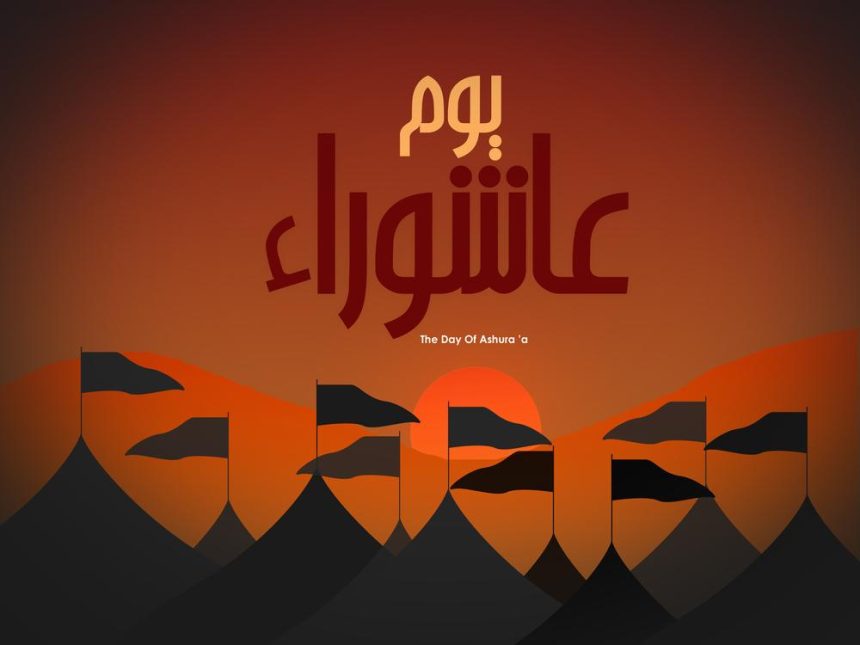
Shafaqna India: For nearly fourteen hundred years, the banner of Ashura has remained unfurled above the soil of Karbala, transforming this city into a sanctuary for the souls of the faithful. With each arrival of Muharram, the landscape of many Shia lands is adorned in shades of crimson and black—a poignant tapestry woven from threads of both elegy and epic. Whether in moments of sorrow or celebration, during the sacred month of Muharram or beyond, the remembrance of Hussain (AS) has remained the crowning jewel of every orator’s speech. One cannot help but ask: what is the secret to this enduring legacy? Where does the mystery of this immortality lie?
There is no doubt that the culmination of Imam Hussain’s (AS) movement was the martyrdom of himself and his companions. The most renowned title—serving as a proper noun—that defines the essence of Imam Hossein is “Sayyid al-Shuhada” (The Master of Martyrs). This signifies that “martyrdom” stands as the most profound achievement of his uprising. Yet, this achievement encompasses four distinct dimensions, each offering a unique perspective: the political, the epic, the emotional, and the mystical. Each has played an instrumental role in the eternal preservation of the Ashura movement. Furthermore, factors such as Divine Will, the pursuit of freedom and honor, alignment with human nature, and unwavering commitment to duty have collectively served as the bedrock of the movement’s enduring vitality and eternal resonance.
Four distinct dimensions of Ashura
Some thinkers posit martyrdom as the ultimate ideal of Imam Hussain (AS); others interpret it as a deliberate strategy employed to achieve specific social objectives; still others view it as a weapon forged to defend human dignity. In all three perspectives, the element of volition and conscious choice remains central. However, there are those who emphasize the Imam’s oppression and the tyranny of his adversaries to such an extent that the “elegy” overshadows the “epic.” In these accounts, the Imam’s agency is often sidelined in favor of highlighting the barbarity of his foes.
Throughout history, these four dimensions—the political, the epic, the emotional, and the mystical—have each risen to prominence depending on the needs of the time, be it a call for Jihad, an appeal to heroism, a requirement for mourning, or a yearning for transcendence. In this view, Imam Hussain’s (AS) “Jihad” was a strategic attempt to topple the corrupt Yazid regime. The Kufans invited him to establish Kufa as a bastion against the Umayyad caliphate; he accepted, traveled there, and remained steadfast unto death, utilizing the strategy of martyrdom—a testament that “blood triumphs over the sword.” Some posit that the Imam’s prescription for all free spirits who find themselves unable to overthrow a tyrant is this very martyrdom: a universal invitation across time and generations to “slay, if you can, and if you cannot, then die.” Here, the “epic” element—the refusal to submit to injustice—is paramount, even independent of the quest for political power. Long before the Kufan letters arrived, the core issue was the Imam’s refusal to pledge allegiance to the corrupt and decadent Yazid, for the Master of the Free would never bow to such immorality.
Human beings possess an innate nature (Fitra) that seeks justice and abhors tyranny. It is precisely because of this nature that people rise up in support of the oppressed and against the oppressor.
Some Ashura poetry and slogans frequently echoed this epic spirit. Allama Iqbal’s poetry, for instance, captures both the epic and political dimensions, presenting martyrdom as both a heroic deed and a strategic necessity:
That Imam of lovers, the son of Batul,
The cypress of freedom in the garden of the Prophet,
He severed the roots of tyranny until the Day of Judgment,
His surging blood cultivated the garden of creation.
Another dimension of Karbala is that of love and mysticism. Here, “martyrdom” ceases to be merely a weapon of exposure; it becomes the sublime act of gazing upon the Divine Countenance and attaining union with the Beloved. This mystical perspective is profoundly articulated by poets like Oman Samani.
Rumi beautifully captures this spirit—a “flight,” a shedding of the self, diving into the ocean of gnosis, and ultimately, “uniting with God”:
Where are you, O God-seeking martyrs?
O seekers of trial in the plains of Karbala!
Where are you, O light-spirited lovers?
More soaring than the birds of the heavens!
Finally, there is the dimension of suffering, thirst, calamity, tragedy, sorrow, and tears. This perspective focuses less on the defiance of injustice and more on the profound pathos of the Imam’s ordeal. It bears a resemblance to the suffering of Christ in Christianity or the shedding of innocent blood in legends like that of Siyavash, though with a crucial distinction: the tragedy of Karbala is an established historical reality, recorded with vivid clarity. Hussain (AS) is a truth that transcends myth, manifested upon the sands of Karbala.
This dimension finds its most poignant expression in the elegies of poets like Mohtasham Kashani:
The ship struck by the storm of Karbala,
Lies fallen in blood and dust upon the field of Karbala.
If the eyes of time were to weep openly for him,
Blood would overflow the arches of the Karbala palace.
The soil of Karbala is inextricably bound to these four pillars: “God,” “the Sword,” “Blood,” and “Tears.” It is precisely this synthesis that grants any event the power of eternal resonance.
Divine Will
The immutable will of the Almighty has ordained that the Hussaini movement of Ashura shall forever remain shielded from the reach of deceivers. The disbelievers seek to extinguish the light of God with their vain words, yet God shall perfect and preserve His light, however much the disbelievers may detest it.
Lady Zaynab (SA) emphasized this truth, asserting the eternal legacy of the Divine Revelation and the Household of the Prophet (PBUH). With profound courage and clarity in the court of Yazid, she declared: “Employ whatever schemes you possess, exert all the effort you can muster, and summon all your forces; but by God, you shall never be able to eradicate the memory of the Household of Revelation, nor shall you ever be able to erase the Quran from the pages of history”,
The pursuit of freedom and honor
“Freedom” is the most beautiful of all words, cherished by every soul. It is for this reason that the prophets and freedom-seekers throughout history have waged struggle against tyrants, striving to liberate the oppressed and establish justice.
Imam Hussain (AS), as the preeminent leader of the free, rose against the enemies of liberty. His uprising emerged at a time when the atmosphere of oppression and despotism had suffocated Islamic society. Yazid and his followers were systematically dismantling the faith, sparing no cruelty against the truth and its adherents. Consequently, the Imam proclaimed that death in the path of God is an ornament, and that refusing to submit to tyranny or succumb to humiliation is the highest form of honor and pride.
The Imam’s unwavering dedication to freedom, his defiance of oppression, and his devotion to the truth have made his movement a source of inspiration even for non-Muslims, who hold him in high esteem—for he taught all of humanity the noble lesson of what it means to be truly free.
Harmony with human nature (Fitra)
Every struggle requires a sustainable foundation to endure and flourish despite the myriad challenges it faces. The primary foundation of any righteous struggle is its inherent justice and truth. When a cause is rooted in justice, it inevitably captivates the human conscience, mobilizes the masses against oppression, and ultimately, sooner or later, achieves practical victory.
Human beings possess an innate nature (Fitra) that seeks justice and abhors tyranny. It is precisely because of this nature that people rise up in support of the oppressed and against the oppressor, transforming both themselves and the society around them in the pursuit of truth. For this very reason, all religious and value-driven movements place justice and the rejection of oppression at the heart of their missions—whether they are calls to monotheism or social reform. Conversely, they strive against deviant and oppressive ideologies, such as atheism or polytheism, both of which stand in stark opposition to this divine nature.
Imam Hussain (AS) proclaimed that death in the path of God is an ornament, and that refusing to submit to tyranny or succumb to humiliation is the highest form of honor and pride.
It is this divine Fitra that makes the common person an advocate for justice and truth, and an adversary to injustice and falsehood. The secret to Imam Hussein’s (AS) success lay in his invitation to monotheism and justice. Because this invitation resonated with the very fabric of human nature, he was able to easily attract souls ready for guidance, such as Hurr.
The essence of Imam Hussein’s call and his movement was in perfect alignment with the human soul. When he spoke, it was as if he were voicing the innermost aspirations of the people. Ultimately, the divine nature of man rejects injustice and betrayal, and by summoning the people to the purity and honesty inherent in their Fitra, Imam Hussein’s (AS) movement became eternal and enduring.
Acting upon one’s duty
What has been ordained upon Muslims by God and faith as “duty” (Taklif) is always designed to serve the common good and prevent corruption. When individuals fulfill their duties, society moves toward purity and spiritual perfection across all its dimensions.
When a culture of “acting upon duty” prevails within a society, its members constantly experience a sense of triumph. As the Holy Quran suggests, they attain one of the “two excellent outcomes” (Ahadal-Husnayain). In their struggles, whether they are martyred or achieve military and political success, both outcomes are desirable to them. The Imams of the Shia acted according to their divine duty under various social conditions. The tragedy of Ashura was itself a manifestation of this commitment to duty. Based on this culture of fulfilling one’s obligation, Imam Hussain (AS) declared:
“If divine decree brings about what we love, we thank God for His blessings and seek His aid to fulfill the gratitude due to Him. And if divine destiny stands between us and what we hope for, then he whose intention is truth and whose inner self is rooted in piety has not transgressed the truth.”
Source: Pasokhgoo, Hawzah, Cgie.