It was only a matter of time before India’s ruling Bharatiya Janata Party (BJP) would add the hitherto elusive jewel of West Bengal, one of India’s largest, culturally most virile and politically most formidable states, to its crown.
In the recently concluded election to the state’s legislative assembly, the BJP has won 207 seats, giving it a two-thirds majority in the 294-member house, unseating the All India Trinamool Congress (AITC). The Mamata Banerjee-led AITC, which had governed West Bengal since 2011, could win in only 80 constituencies, drastically down from 215 in 2021.
Politically, West Bengal is one state in the Indian Union that, for decades, has charted an independent course, different from the rest of India. In 1977, Jyoti Basu led the Communist Party of India-Marxist (CPI-M) to triumph in the election to the state’s legislative assembly, comprehensively defeating both the Indian National Congress (INC) and the Janata (People’s) Party.
Basu remained at the helm until 2000 before making way for his comrade Buddhadeb Bhattacharjee. In all, the CPI-M remained in the saddle in West Bengal for 34 years uninterruptedly, until 2011. Neither the INC nor the BJP, nor any other party, could breach its fortress during that period, visibly demonstrating the electorate’s preference not only for charting an independent political course but also for a long-term commitment to one political party.
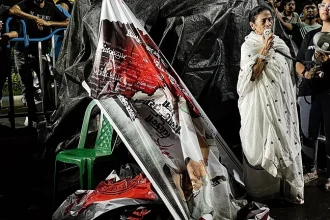
The lady whom destiny chose to breach the CPI-M’s seemingly impregnable fortress was Mamata Banerjee. Starting off as an INC activist, she broke ranks with the party in 1998 and founded the AITC. In 2011, she became West Bengal’s first woman chief minister and spearheaded her party to another two back-to-back electoral triumphs in 2016 and 2021. Called by her supporters both ‘the fire goddess’, because of her fearlessness, and ‘Didi’ (elder sister), because of her concern for common people and women, she ensured West Bengal resisted the electoral onslaught of the BJP, which in the meantime had swept through most of India.
Geographically-cum-ethnically, it’s customary to divide India into five parts: (a) the Hindi heartland or North-central India comprising nine states including the most populated state of Uttar Pradesh (UP) and making up 40 per cent of Indian population; (b) Western India comprising three states including Maharashtra and Gujarat, which together constitute the country’s industrial and commercial hub; (c) South India comprising five states and having a distinct ‘Dravidian’ cultural identity as opposed to the dominant ‘Aryan’ culture; (d) East India comprising four states including West Bengal; and (e) North-east India comprising eight states. Linguistically, Bihar is part of the Hindi heartland, while geographically it’s part of East India.
Of the 28 Indian states, the BJP and its coalition partners in the National Democratic Alliance (NDA) ruled 21 before the 2026 West Bengal election. These include seven states in the Hindi heartland, including notably UP; all three states in western India; three of the four states in East India; and all states in North-east India. The states in South India and West Bengal were the only ones to have resisted the BJP’s electoral expansion. West Bengal, which has now gone to the BJP as well, is the only part of South India where the BJP has not been able to capture power.
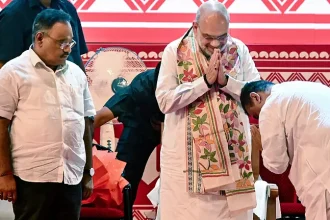
Thus, three interrelated principal implications of the West Bengal election are that the BJP is now in control of the whole of East India; that for the first time a right-wing party has won the polls in the state; and that the party has come even closer to ruling the entire country – and do so principally in the name of Hindutva.
For decades, the legislative assembly polls in West Bengal remained primarily a contest between left-wing or centre-left parties. Right-wing parties, like the BJP, were nowhere on the electoral scene. As late as 2011, the BJP failed to win a single seat in the state. In 2016, the party opened its account by winning three seats and 10.3 per cent of the popular vote. The BJP had already won the 2014 national elections with Narendra Modi in the van, indicating that West Bengal was still immune to the party’s Hindutva narrative.
In 2021, however, the BJP secured 77 seats and 38.4 per cent of the popular vote. The party finished second behind the AITC’s 215 seats and 48.5 per cent of the popular vote. The results were an unmistakable signal that the Hindutva narrative was gaining a foothold in the state, which had traditionally strong secular credentials. It was only a matter of time before the BJP would oust the AIMC, given its control of constitutional institutions, such as the superior courts and the Election Commission of India, its enormous financial resources, and the media’s full support. Hence, while in 2026 the margin of the BJP’s victory may be much more surprising, the victory itself isn’t.
Some analysts have attributed the BJP’s star performance partly to alleged corruption by the outgoing Mamata Banerjee government and partly to the incumbency factor. The analysis seems unsound. For one thing, the incumbency factor doesn’t make much sense in a state that has seen only one change of government in about half a century: a 34-year rule by the CPI (M) and a 15-year rule by the AIMC. For another, in our part of the world, corruption by itself doesn’t play a decisive role in determining electoral outcomes because of the strong emotional attachment people have to the parties and leadership, as well as a culture of patronage.
Muslims make up about 27 per cent of West Bengal’s population, and the state accounts for the second largest Muslim population of India (24.7 million) after UP (38.4 million). The Muslim vote has been the mainstay of the AIMC’s electoral strength. In 2021, the party won in 84 out of 88 Muslim-majority constituencies, prompting the BJP to play its Hindutva trump card in the run-up to the 2026 election. Soon after the results were announced, a top BJP leader in West Bengal publicly stated that since all Muslim votes had gone to the AIMC and his party owed its victory to the Hindu vote, their government would work only for Hindus.
The other related factor was the controversial revision of West Bengal’s electoral rolls called Special Intensive Revision (SIR). Undertaken with the avowed purpose of cleaning up voter lists, the revision allegedly disenfranchised some nine million voters — including 3.1 million Muslims — out of some 76 million voters in the state. Prime Minister Narendra Modi had himself stated while campaigning in West Bengal that the clean-up was aimed at identifying ‘illegal Bangladeshi infiltrators.’ The AIMC alleged, however, that the premier was referring to Muslims.
At any rate, after West Bengal fell to the BJP, South India is currently the only bulwark against Hindutva in the world’s most populous and once-secular country, known for its religious and cultural diversity. How long the South Indians can survive Hindutva’s onslaught is anybody’s guess. For now, the BJP juggernaut seems unstoppable.
Source: Shafaqna do not endorse the views expressed in the article