By Jaideep Hardikar
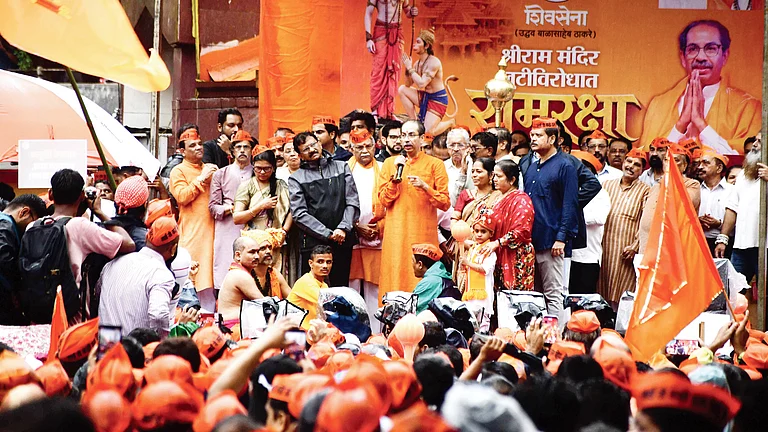
On a humid Sunday morning, just before heavy rain drowned Mumbai, Uddhav Thackeray stood before his party workers and supporters, reciting the Ram Raksha stotra. This was not an election campaign. After yet another round of desertions by his party’s Lok Sabha members, Thackeray was leading a ‘Ram Raksha andolan’ to protest the alleged embezzlement of donations by the BJP/RSS-backed trust managing the Ram temple in Ayodhya.
Standing amid saffron flags, he accused the BJP of exploiting the faith of millions of Hindus and declared that “Hindus are innocent, not foolish.” The symbolism was unmistakable: a leader who has spent the last four years fighting politically and legally to retain his party’s identity and control was returning to the ideological terrain that his father, late Bal Thackeray, had cultivated for decades. Yet beneath the chants and the verses lay a deeper anxiety.
The protest was less a confident assertion of ideology than a weak, almost desperate effort to reclaim political ground that has steadily slipped away since the rebellion of 2022 by his trusted aide-turned-bête noire Eknath Shinde. Shinde continues to eat into Sena (UBT), enticing its MLAs, MPs and foot soldiers to join his fold to enjoy the fruits of power. The latest defections — six of the nine members elected in 2024 on Sena (UBT) tickets and one MLC close to Aaditya Thackeray — underline the same trend.
Late last year, Sena (UBT) finally lost control over the prized Brihanmumbai Municipal Corporation (BMC) with the BJP–Shinde Sena–NCP (Ajit Pawar) combo sweeping the elections. Electoral losses aside, every defection or rumour that another legislator is switching sides chips away at the confidence of a party that has already lost its name, its election mascot, much of its legislative strength and a sizeable part of its organisation.
****
The Opposition alliance has only 46 MLAs in a 288-member house if you count only the three MVA (Maha Vikas Aghadi) constituents. Neither the Sena (UBT) with its 20 MLAs nor the Congress (with 16) nor the NCP (Sharad Pawar) with 10 meets the one-tenth threshold (of 29 MLAs) required for a party to claim the statutory post of leader of the Opposition. This is the first time in about six decades that the Maharashtra Assembly has no LoP. It shows in the way legislature proceedings are conducted, with no serious discussion on any public issue.
The political vacuum may create an opening for the Congress, the only national party with a presence, however weak, across the state, but it’ll be a long haul.
****
As his party continues to bleed MPs, MLAs, corporators and local office-bearers, driven by the allure of power and big contracts, the big challenge for Uddhav Thackeray is to convince loyalists and fence-sitters that his party still has a viable future. Politics ultimately rewards confidence. Cadres stay with organisations that appear capable of winning elections, protecting careers and distributing political opportunities.
The party’s greatest asset today is Uddhav Thackeray’s personal credibility. Son Aaditya is not yet ready to take on the mantle. Unlike many contemporary politicians, Uddhav is perceived as measured and dignified. His handling of the Covid-19 pandemic earned him goodwill beyond his traditional support base. Many sympathised with him after the Shinde rebellion, but sympathy cannot sustain a political organisation.
Source: national Herald
Note: Shafaqna do not endorse the views expressed in the artcle