Shafaqna India: The season’s first spell of heavy monsoon rain turned Gurugram into a city of chaos on Tuesday, exposing the fragile state of its infrastructure as roads caved in, highways disappeared under sheets of water and crippling traffic snarled commuters for hours across the National Capital Region.
What began as a steady afternoon downpour quickly snowballed into a civic nightmare. Between 2 pm and 4 pm, the city received up to 82 mm of rainfall, overwhelming drains, inundating key roads and triggering cave-ins at multiple locations. As vehicles crawled through waterlogged streets, the administration’s repeated assurances of a “waterlogging-free” monsoon were washed away within hours.
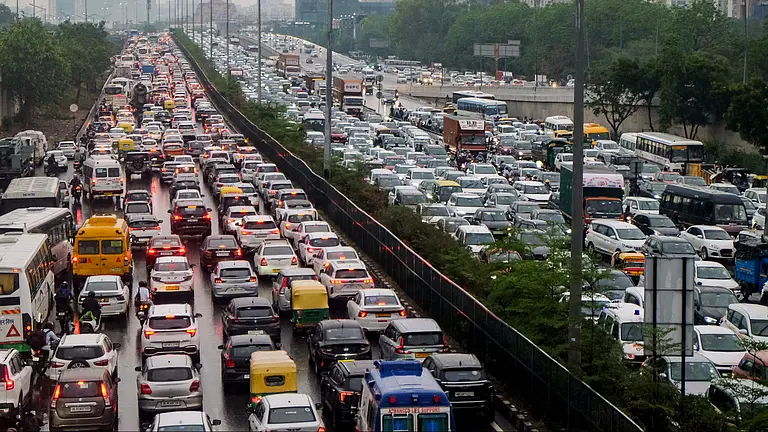
The worst-hit stretch was the Delhi-Jaipur Highway (NH-48), where the main carriageway near Narsinghpur caved in under the relentless rain, forcing authorities to shut two lanes. The closure sparked a mammoth traffic jam stretching several kilometres between Hero Honda Chowk and the Kherki Daula Toll Plaza, trapping office-goers, families and commercial vehicles in bumper-to-bumper traffic.
In response, Gurugram Police issued a traffic advisory and diverted vehicles heading from Delhi towards Jaipur. “To ensure smooth traffic flow and prioritise the safety of motorists travelling from Delhi towards Jaipur, route diversions have been implemented,” the advisory said. GeographicReference
The rain also exposed the city’s crumbling civic works. On Civil Line Road, a freshly excavated stretch for sewer-laying collapsed after the downpour, swallowing the tyres of two parked vehicles. Ironically, the cave-in occurred barely 100 metres from the official residence of Gurugram deputy commissioner Uttam Kumar. The residences of municipal corporation commissioner Pradeep Dahiya and Haryana minister Rao Narbir are also located on the same road, making it one of the city’s most prominent VVIP stretches.
Residents were quick to point out the irony. If one of Gurugram’s most important roads could crumble after the first heavy shower, they wondered what conditions must be like in the city’s less privileged neighbourhoods.
Elsewhere, the familiar monsoon woes returned with full force. Major arterial roads and intersections disappeared beneath stagnant water, reducing traffic to a crawl and leaving thousands stranded. Social media platforms were flooded with videos showing submerged roads, stalled vehicles and endless queues of traffic stretching into the distance.
The timing of the rain compounded the disruption. As schools closed for the day, students and school buses became caught in the gridlock. In one alarming incident, a school bus slipped into an open drain along NH-48. Fortunately, no children were onboard, averting what could have been a serious tragedy.
Traffic bottlenecks were reported from nearly every corner of the city, including Narsinghpur, Basai, Hero Honda Chowk, Golf Course Extension Road, Rajiv Chowk, Vatika Chowk, Iffco Chowk, Udyog Vihar, Sohna Road, Khandsa Road, Old Delhi Road, Pataudi Road, the Millennium City Centre-Hero Honda Chowk stretch, Old Gurugram-Delhi Road, Basai Road, and roads leading to both the Old and New Railway Stations.
Even as rain continued to lash the city, traffic police personnel remained on the streets, manually regulating traffic amid waterlogged junctions. Senior officers fanned out across affected locations to monitor the situation and direct relief measures.
Official rainfall figures underscored the intensity of the downpour. Kadipur and Harsaru recorded the highest rainfall at 82 mm each, while Gurugram tehsil received 76 mm. Manesar recorded 50 mm, Wazirabad 49 mm, Pataudi and Sohna 26 mm each, Farrukhnagar 27 mm and Badshahpur 15 mm.
Authorities acknowledged that continuous rainfall had submerged underpasses and several low-lying stretches, with waterlogged roads, potholes and stranded vehicles causing widespread congestion.
To mitigate the crisis, Gurugram Police launched an extensive response, deploying additional personnel at critical intersections while coordinating with the Municipal Corporation, the Gurugram Metropolitan Development Authority (GMDA) and other civic agencies to drain water, clear obstructions and repair damaged roads.
Heavy machinery, including cranes, recovery vehicles, pumps and water tankers, was pressed into service to rescue stranded vehicles and restore mobility. Private equipment was also requisitioned wherever necessary. Damaged and stalled vehicles were moved to safer locations while police personnel continued to regulate traffic at vulnerable underpasses and major junctions despite the relentless rain.
With more showers forecast, Gurugram Police issued an advisory urging corporate offices and private establishments to allow employees to work from home over the next few days to reduce traffic volume and ease pressure on the city’s strained road network.
“We strongly urge the corporate sector and private establishments to encourage Work from Home arrangements for their employees. Minimising non-essential vehicular movement will greatly assist our traffic management teams and ensure emergency services remain unobstructed,” the advisory said.
Police said deployment had been strengthened across all zones and coordination with civic departments would continue until waterlogging and traffic disruptions were fully addressed. Yet, for thousands of commuters who spent hours trapped on flooded roads, the season’s first major shower served as another stark reminder that Gurugram’s monsoon vulnerabilities remain far from resolved.
Source: Natonal Herald